Frequently Asked Questions About Probate
Kansas Probate Process: Key Steps, Responsibilities, and Court Involvement
What is Probate?
Probate is the legal process of proving a will and administering the estate after someone passes away. All estate administration proceedings are involved in this process.
- → It’s the practice of deciding what to do with the deceased person's assets.
A person’s “estate” is their property at the time of death. Note that some property passes directly to others and is excluded from probate:
- → Properties held in joint tenancy, life insurance proceeds, and retirement plans payable to a named beneficiary bypass probate.
- → Everything else may be subject to probate, typically administered in the county where the deceased owned property.
Why is Probate Necessary?
Probate serves several critical functions for settling an estate and ensuring legal transfer of property:
- → To validate the deceased's legal will.
- → To assign an executor or administrator to manage the estate.
- → To collect, define, and protect all property of the estate.
- → To facilitate the payment of existing taxes and debts promptly.
- → To determine beneficiaries and divide the property correctly.
- → To transfer legal ownership of titled property.
Key Roles and Procedural Steps
Naming the Fiduciary: The will names an executor; if there is no will, the court appoints an administrator. This individual is personally responsible for the proper handling and settlement of the estate, usually under the guidance of a lawyer.
Primary Duties of the Executor / Administrator
- • Notify heirs and creditors of the proceedings.
- • Inventory and preserve the probate assets.
- • Collect all income, debts, claims, and notes due.
- • Determine and pay all state and federal inheritance, estate, and income taxes.
- • Pay valid creditor claims, selling property if necessary.
- • Distribute all remaining assets to the proper persons.
The probate process itself requires preparing and filing several legal documents, publishing notices, holding court hearings, and securing the final release of the fiduciary by the court.
What is the Role of the District Court?
All probate proceedings in Kansas are subject to the authority of the District Court. The acts of the executor or administrator are subject to the court's scrutiny and approval, except for estates administered under the Simplified Estates Act and Informal Administration Act.
- → The Court makes final determinations, including payment of large debts (over $1500), allowance of fees, and final distribution orders.
- → Important: Juries are not used in probate matters.
How Long Does Probate Take?
An exact time schedule cannot be given, as each estate differs. However, there are strict deadlines that must be met:
CRITICAL DEADLINES:
- • WILL FILING: The petition must be filed within 6 months after the date of death.
- • TAX PAYMENTS: State and federal death tax payments are due no later than 9 months after the date of death.
Typical Timeframes Post-Filing:
- → Appointing an executor usually takes 4 to 5 weeks from the date the petition is filed.
- → Creditors have 4 months after actual notice to file claims against the estate.
- → No estate with assets beyond allowance/debts may be closed before 6 months after the date of death.
Property Excluded from Probate
Not all property owned by the deceased is subject to the probate process. Non-probate assets pass directly to survivors and bypass the deceased’s will, which can sometimes weaken the deceased's wishes about distribution.
- Life insurance (unless the beneficiary is the estate or executor).
- Joint tenancy property with right of survivorship.
- Bank accounts with a “pay on death” provision.
- Assets with Transfer on Death provisions (securities, titled vehicles, real estate).
Tax Liabilities Involved
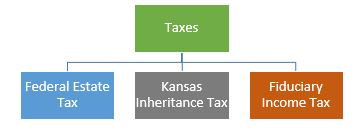
The taxable estate is distinct from the probate estate, as it includes both probate and non-probate assets. Every estate may be subject to several types of death taxes.
- A. Federal Estate Tax: Based on the net value of assets after large deductions/exemptions. Consult a lawyer, as many estates owe no tax.
B. Kansas Inheritance Tax: Based on the value of assets received and the heir's relationship to the deceased. This may be payable even if no federal estate tax is due.
• Waiver Requirement: Kansas real estate requires an *Inheritance Tax Waiver* filed with the Register of Deeds for clear title transfer, unless the deceased died over 10 years prior.- C. Federal and State Fiduciary Income Tax: Based on income and expenses created from the probate estate assets.

Tax Complexity Warning: Due to the complexities involved, especially since non-probate assets may still be taxable, an executor should not attempt to draft the necessary tax returns or compute taxes without the supervision and guidance of a lawyer.
Fees and Costs
The fees for the administrator and the lawyer are not fixed by law. They must reflect the fair value of services performed relative to the estate's size and are subject to the approval of the probate court.
Estate administration costs also include court fees (set by law), publication costs, and bond premiums (if a bond is required).
Special Provisions for Small Estates
"Refusal to Grant Letters of Administration"
A simplified proceeding available when a deceased leaves a spouse or minor children, provided the estate meets strict criteria:
- • Estate is entirely personal property.
- • Estate value does not exceed the amount of exempt property.
- • Estate does not exceed the maximum family allowance of $25,000.
Note: If the deceased had no will and left only real estate, a Determination of Descent proceeding may be started any time 6 months after death, which typically takes about 30 days to complete.
Need Legal Assistance?
Attending to the details of a probate proceeding can be a complex, time-consuming task. Dealing with this while grieving can be overwhelming.
A lawyer has the technical ability to smoothly handle the necessary legal procedures and relieve those grieving of this significant burden.
Immediate Steps After Death
Property: Nothing should be done to disturb any of the deceased’s property unless it is necessary to protect it from being lost or destroyed.
Contacting Counsel: Shortly after the death, a lawyer should be contacted.
- → The surviving spouse should generally make the initial contact. In other situations, the closest relatives are recommended.
- → The lawyer will give advice, determine if probate is needed, explain the procedures, and should be provided with the deceased's will at the first consultation.
Topics
Tags